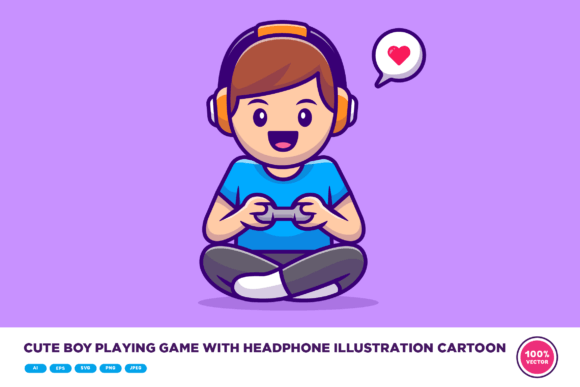
Boy Playing Game Illustration: Practical Applications for Modern Digital and Print Design
When you download a Boy Playing Game Illustration in vector format, you are acquiring more than just a static image; you are securing a flexible design asset capable of adapting to countless visual contexts. This specific EPS 10 file serves as a foundational element for projects ranging from mobile app interfaces to large-format printed banners. Because it is constructed from mathematical paths rather than pixels, this illustration maintains crisp edges and vibrant colors whether it is scaled down to a 32-pixel icon or blown up for a storefront window decal. For designers, marketers, and content creators aged 20 to 50, understanding the practical utility of this asset goes beyond simple aesthetics—it is about leveraging scalable graphics to solve communication problems efficiently.
Enhancing User Experience in Web and Mobile Interfaces
The most immediate application for this Boy Playing Game Illustration lies within digital product design. In an era where user attention spans are fleeting, visual cues often communicate faster than text. If you are designing a gaming platform, an educational app for children, or a parental control dashboard, this illustration acts as an instant semantic anchor. Users recognize the pose and the controller immediately, understanding the context without reading a label.
Consider the onboarding flow for a new mobile game. Using this vector illustration during the tutorial phase can soften the learning curve. Unlike aggressive, hyper-realistic 3D renders that might intimidate casual players, a clean vector style feels approachable and friendly. It signals that the experience is accessible. Furthermore, because the file is in EPS 10 format, UI designers can easily extract individual elements. You might use the full composition for a landing page hero section but isolate just the character’s head or the game controller for navigation icons or achievement badges within the app itself. This modularity ensures visual consistency across different screen densities and device sizes without requiring multiple export versions.
Optimizing for Retina and High-DPI Displays
One of the persistent challenges in modern web design is ensuring graphics look sharp on high-density screens. Raster images often require serving multiple resolutions (1x, 2x, 3x) to prevent blurriness. With this vector-based Boy Playing Game Illustration, that redundancy is eliminated. The graphic renders natively at the device's exact pixel ratio. For developers and front-end designers, this translates to cleaner code and potentially faster load times when converted to SVG for the web. The lightweight nature of vector paths compared to heavy PNG or JPEG files contributes to better Core Web Vitals scores, which is a tangible SEO and performance benefit for any gaming-related website.
Strategic Use in Marketing and Advertising Campaigns
Beyond interface design, this illustration serves as a versatile workhorse for marketing teams targeting gamers or families. The vector format allows for rapid iteration, which is crucial in fast-paced advertising environments. When running A/B tests on social media ads, you can quickly modify the color palette of the illustration to match different seasonal themes or brand guidelines without returning to the drawing board. Need a blue version for a tech-focused ad and a warm orange version for a holiday sale? Both can be generated from the same source file in minutes.
This adaptability extends to cross-channel campaigns. A marketing manager might use the full-color version for a Facebook carousel ad, then switch to a single-color silhouette for a minimalist email newsletter header, and finally use a high-resolution CMYK export for a direct mail postcard. The Boy Playing Game Illustration bridges the gap between digital and physical touchpoints, maintaining brand recognition regardless of the medium. For agencies managing multiple clients, having a reliable, licensable vector asset like this reduces production time significantly compared to commissioning custom artwork for every minor campaign variation.
Print Design and Merchandising Considerations
While digital use is prominent, the print capabilities of this EPS 10 file should not be overlooked. Vector graphics are the industry standard for apparel printing, sticker production, and signage. If you are creating merchandise for a gaming tournament or designing packaging for a board game, this illustration provides the necessary fidelity. Screen printers prefer vectors because they allow for precise color separation. Direct-to-garment (DTG) printers benefit from the infinite resolution, ensuring that details in the character’s expression or clothing texture remain sharp even on dark fabrics.
However, practical preparation is key. Before sending this Boy Playing Game Illustration to a print vendor, verify the color mode. Vectors created for web are typically RGB, while professional printing requires CMYK. Converting early prevents unexpected color shifts, particularly with bright neon greens or blues common in gaming aesthetics. Additionally, check that all strokes are expanded and fonts are outlined. This prevents compatibility issues if the print shop uses a different version of Illustrator or lacks your specific typefaces.
Educational and Editorial Contexts
Content creators in the education and publishing sectors find unique value in this type of imagery. Textbooks, e-learning modules, and blog posts discussing digital literacy, screen time balance, or child development often need visuals that represent gaming without glorifying violence or promoting specific commercial titles. A generic, stylized Boy Playing Game Illustration fills this niche perfectly. It represents the act of gaming rather than a specific product, making it legally safer and contextually broader for editorial use.
In educational materials, the friendly vector style helps demystify technology for older demographics or parents who may feel alienated by hardcore gaming culture. It presents gaming as a normal, manageable activity. For bloggers writing reviews or guides, using a consistent vector style across multiple articles creates a cohesive visual identity that distinguishes their site from competitors relying on generic stock photography. The ability to recolor the illustration to match article categories—perhaps green for "Tips," red for "Warnings," and blue for "Reviews"—adds a layer of functional design that enhances readability and user navigation.
Technical Compatibility and Workflow Integration
Understanding the technical specifications of the EPS 10 format is essential for maximizing the utility of this download. EPS 10 is a widely supported legacy standard that balances modern features with backward compatibility. It opens reliably in Adobe Illustrator CC, CS6, and even older versions, as well as in alternative software like Affinity Designer, CorelDRAW, and Inkscape. This broad compatibility makes it an excellent choice for collaborative teams where members may use different tools or operating systems.
- Layer Management: Upon opening the file, assess the layer structure. Well-organized vector files group related elements (e.g., "Character," "Controller," "Background Effects"). This organization speeds up editing and reduces the risk of accidentally moving unrelated components.
- Scalability Checks: Always test the illustration at its smallest intended size before finalizing a design. Complex gradients or thin lines that look great at 100% may disappear or create moiré patterns when scaled down to thumbnail size.
- Export Flexibility: While EPS is the master format, maintain exported copies in SVG for web, PDF for print proofing, and transparent PNG for quick mockups. This multi-format approach streamlines workflows across different departments.
Navigating Style and Audience Alignment
Before integrating this Boy Playing Game Illustration into a project, critically evaluate whether the artistic style aligns with your target audience. Vector art inherently carries a certain tone—often modern, clean, and slightly playful. This works exceptionally well for casual gaming, ed-tech, family services, and general consumer tech. However, it may feel out of place for hardcore simulation games, horror genres, or luxury tech products where photorealism or gritty textures are expected.
Consider the demographic representation as well. While this specific illustration depicts a boy, think about how it fits into your broader visual strategy. If your product appeals to all genders, ensure this asset is balanced with inclusive imagery elsewhere in your design system. Alternatively, leverage the vector format to create variations. Changing hair color, clothing styles, or skin tones in the source file can help build a diverse library of assets from a single base, promoting inclusivity without additional licensing costs.
Ultimately, the value of this Boy Playing Game Illustration lies in its versatility and efficiency. It solves the dual challenge of needing high-quality visuals that work across both digital and print mediums while remaining editable enough to fit specific brand requirements. By treating this EPS 10 file as a dynamic design component rather than a static picture, professionals can extract maximum ROI, streamline production workflows, and create more engaging, cohesive experiences for their audiences. Whether you are building an app, printing a t-shirt, or illustrating a blog post, this vector asset provides the professional foundation needed to execute your vision with clarity and impact.